Where Bright Ideas
Come to Life!
Come to Life!
If you've ever watched an electrician open a wall or lift a floorboard, you'll have seen it — flat grey cable running in every direction, disappearing into joists and ceiling voids. That cable is the backbone of your electrical installation. It carries power to every socket, light and fixed appliance in the building, and most people have no idea what's actually inside it.
This article covers the two cable types you'll find in almost every UK property: twin and earth and 3-core and earth. We'll cover what's inside each one, what the different sizes are used for, how much current they carry, and where you'll find each one in a typical home or business. If you're a homeowner trying to understand your own wiring, a landlord working out what you're responsible for, or a business owner about to have electrical work done, start here.
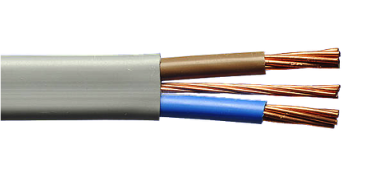
Twin and earth is the standard fixed wiring cable used in UK domestic and commercial electrical installations — the flat grey cable you'll find behind almost every wall. Inside the outer PVC sheath there are three conductors:
It's called “twin and earth” because there are two insulated conductors (live and neutral) plus the earth, which isn't counted as a full core since it has no insulation of its own. It's manufactured to BS 6004 and sized by the cross-sectional area (CSA) of the copper, measured in mm² — the bigger the number, the more current it carries.
It depends entirely on the circuit. Each size is matched to an expected load, and the table below is what our electricians specify against in day-to-day work across Tonbridge, Tunbridge Wells, Sevenoaks and Crowborough.
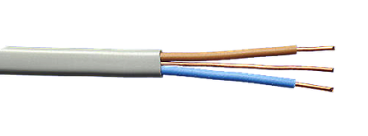
Carries roughly 14A clipped to a surface, around 3,000W at 230V. This is what runs your downlights, pendants and wall lights, protected by a 6A breaker. It also feeds smoke alarm supplies and doorbell transformers. Not rated for power circuits or ring mains.
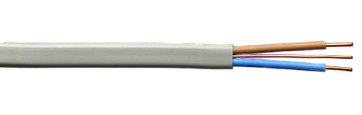
Around 18A, 4,000W. Used for lighting circuits with more fittings — larger homes and commercial premises — plus immersion heaters, lower-wattage showers where regulations allow, and some storage heater circuits.
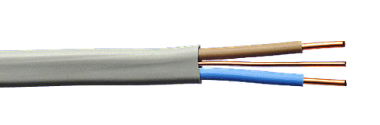
Around 24A clipped to a surface. This is the cable behind almost every socket in the country — ring mains and radial socket circuits alike, plus dedicated appliance circuits for washing machines, dishwashers and fridges. If you're extending a ring main, new sockets should be wired in 2.5mm² to match — mixing cable sizes on one circuit without proper protection isn't acceptable.
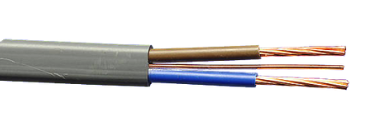
Around 32A, 7,300W. Specified for smaller cookers, induction hobs in the 5–7kW range, and EV chargers at the lower end of the charging range.
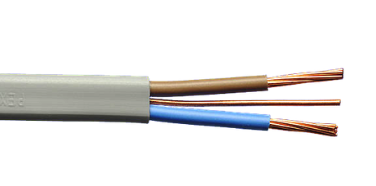
Around 40A, 9,000W. Covers 7.5–9kW electric showers, larger cookers, and mid-range EV chargers. A 9.5kW shower draws around 41A — comfortably within 6.0mm²'s capacity behind a 40A or 45A breaker. Running that same shower on 2.5mm² would overheat the cable under sustained load; the correct size is chosen at the design stage, not left to the breaker to compensate for.
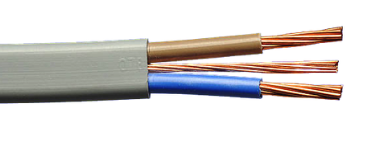
Around 53A, 12,000W. Used for 10.5kW+ showers, larger cookers, bigger EV chargers, and as sub-main feeds to outbuildings or workshops in smaller commercial properties.
Around 70A. You won't find this wiring sockets or lights — it's the cable between the electricity meter and the consumer unit (meter tails), sized to handle the property's total demand rather than a single circuit. It's also used as a sub-main feed to a garage, annexe or workshop with its own consumer unit. Meter tails aren't backed up by a circuit breaker at the consumer unit end — the DNO's service fuse is the only protection — so getting the size right matters. Older properties sometimes have undersized tails, and it's common to replace them during a consumer unit upgrade.
Not sure what's behind your walls? Book an EICR or a consumer unit assessment and we'll tell you exactly what you've got and whether it's fit for purpose. Call 01892 531 728 or email karen@brightsparkelectrician.co.uk.
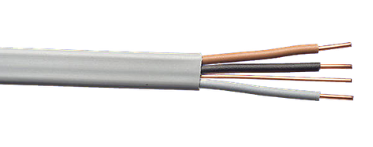
Once you understand twin and earth, 3-core and earth is a straightforward next step — same PVC-sheathed construction, but with an extra insulated conductor. Inside, there are four conductors:
That third insulated core is what makes the difference — it opens up a switching signal, a second live feed, or an interconnect path that twin and earth simply can't carry. Unlike twin and earth, it's round rather than flat, which makes it easy to spot in a consumer unit or junction box.
The most common domestic use. A two-way switch — the classic staircase light controlled from top and bottom — needs two “strapper” conductors (common, L1, L2) running between the two switch positions, plus a live feed. That's three conductors, which is why 3-core and earth runs between the switches. Any hallway, landing or bedroom light switched from two positions will have a run of it.
Add a third or fourth switch position to a two-way circuit and you have intermediate switching, common in long corridors, open-plan spaces and rooms with multiple entrances. Each intermediate switch position uses 3-core and earth in the same way — the wiring gets more complex, the cable stays the same.
Modern interlinked smoke alarms — required on new domestic installations and strongly recommended for rentals — run on 3-core and earth between each alarm head. Each alarm needs a permanent live and neutral, plus an interconnect wire carrying the trigger signal. That third conductor is what makes every alarm in the property sound together when one detects smoke, rather than each one operating alone.
Some storage heater circuits, particularly older Economy 7 or Radio Teleswitch installations, use 3-core and earth. The extra conductor carries the switching signal that controls overnight charging while keeping a permanent live supply to the unit. If a property still has storage heating, this is likely what's feeding it.
Less common, but 3-core and earth turns up in retrofit and specialist installations wherever a control or signal conductor needs to run alongside a standard supply.
The same conductor sizes as twin and earth, with broadly equivalent current-carrying capacities at each size:
Actual rating varies with installation method — clipped to a surface, in conduit, buried in plaster or run through insulation — so the exact size is a design decision, not a table lookup.
Not on their own. If a property was built or last rewired before around 2005, the cable may still be in the old colour scheme — red and black for twin and earth, red/yellow/blue for 3-core and earth. The change to brown/blue and brown/black/grey came in 2004 to align with European standards, phased in over the following couple of years. An old red conductor is just as safe as a new brown one, provided the cable and connections are in good condition — the colour tells you when the circuit was last touched, not whether it's dangerous. It's common to find both colour schemes in the same consumer unit where a property's been partially rewired over the years. During an EICR, our electricians note old-colour cable as part of assessing the installation's age and history.
Yes, significantly. Undersizing a cable is one of the more common mistakes in poor electrical work. A cable running under a load it's not rated for runs hotter than it should — the circuit breaker should trip before it becomes dangerous, but in real installations, cables buried in walls, run through insulation or bundled with others dissipate heat less efficiently. A cable that's fine in free air can become a genuine hazard once installed in conditions that restrict cooling.
The capacities in this article assume the cable is clipped to a surface in free air. Bury a 2.5mm² cable in thermal insulation and its safe capacity can drop from 24A to as little as 13A. Bundle cables together and each one heats the others; run them in conduit and heat dissipation drops further. This is why sizing a cable is a proper calculation, not a table lookup — it's a standard part of circuit design for any NICEIC-registered electrician, and it's one of the things that separates a properly designed circuit from one that's just been got in.
On a standard domestic installation:
Commercial properties follow the same principle at a larger scale — more circuits, bigger loads, and a wider spread of cable sizes depending on what the building's actually doing. A workshop with machinery, an office with dedicated IT circuits, or a kitchen with heavy catering equipment will all look different once you're behind the consumer unit.
Planning work that involves rewiring, a new circuit, or an EICR? We cover Tonbridge, Tunbridge Wells, Sevenoaks and Crowborough — get in touch on 01892 531 728 or karen@brightsparkelectrician.co.uk and we'll come and take a look.
If you're having sockets, lighting or fixed appliances added, the new cable should match the existing circuit — a thinner cable spliced into a 2.5mm² ring main without a design reason is worth questioning. If an EICR flags cable undersizing, that's a genuine safety finding, not box-ticking. If you're buying an older property, the cable colours and sizes in the consumer unit tell you a lot about when it was last updated — old-colour cable and rewirable fuses with no RCD protection point to wiring that hasn't been touched in decades. And if you're a landlord, an EICR every five years (or at each change of tenancy) is a legal requirement — understanding that your tenant's kitchen sockets should be on 2.5mm², or that interlinked smoke alarms need 3-core and earth to function as a system, means you can read the test report properly instead of taking it on faith.
Twin and earth has two insulated conductors (live and neutral) plus a bare earth. 3-core and earth adds a third insulated conductor, used for a switching signal, an interconnect wire, or a second live feed — most commonly in two-way lighting circuits and interlinked smoke alarms.
2.5mm² twin and earth is the standard size for ring main and radial socket circuits in UK homes, protected by a 32A circuit breaker. It's also used for dedicated appliance circuits such as washing machines and dishwashers.
It depends on the shower's kW rating. A 7.5–9kW shower typically needs 6.0mm² twin and earth; a 10.5kW and above usually needs 10.0mm². An electrician sizes the cable to the shower's actual current draw and the installation conditions, not just a rule of thumb.
Two-way switching — controlling one light from two switch positions, like a staircase — needs two strapper conductors between the switches plus a live feed. That's three conductors, which is why 3-core and earth is run between the switch positions instead of standard twin and earth.
Not in themselves. Red and black were the standard UK cable colours before 2004, and old-colour cable is just as safe as new-colour cable if it's in good condition. It does tell an electrician the circuit hasn't been touched since before the mid-2000s, which is useful context during an EICR.
16.0mm² twin and earth is standard for meter tails on a typical domestic property. Larger properties with higher overall demand may need 25.0mm². Meter tails aren't backed up by a circuit breaker at the consumer unit, so they need to be correctly sized from the outset.
No, not without a specific design reason and the correct protection. A circuit should be wired in a consistent cable size matched to its protective device. If you're extending an existing ring main, the new cable should match the 2.5mm² already in use, not a thinner substitute.
Internal links to add within the body copy above (developer: anchor text shown, hyperlink to URL):
Wiring questions of your own? Our NICEIC-registered electricians cover Tonbridge, Tunbridge Wells, Sevenoaks and Crowborough — call 01892 531 728 or email karen@brightsparkelectrician.co.uk and we'll help you make sense of what's behind your walls.
Thank you also for such a brilliant service, it’s been a pleasure dealing with you from start to finish, and your team member today was fantastic too. I would have absolutely no hesitation using you for electrical work in future and recommending you to friends. Now, if you could just set up a building and plumbing company too… ha ha!
We are very pleased with the high standard of the recent work carried out by Bright Spark and would happily recommend the service. We were particularly impressed by the quick response to our online enquiry and the email follow up by Karen after the job had been completed. We will definitely use her for any electrical job in the future.
Karen runs a great company. She is that very rare breed of taking care, respecting and rewarding her employees. In turn, Terry who carried out our work showed due care and attention and completed works with such professionalism. He interacted with my inquisitive little boy who may, one day may, become an electrician - he certainly had a great role.model to follow!
I have always found Karen and her team at Bright Spark to be friendly, professional and reliable. Their quotes have been reasonably priced and provide a thorough breakdown of costs for replacements parts and labour. I highly recommend them.
Karen was amazing I can not recommend her highly enough she went over and above my expectations and was indeed a bright spark to my day and helped with love ❤