
Where Bright Ideas
Come to Life!
Come to Life!
Walk into almost any commercial building, block of flats, care home or church that's been built or rewired in the last thirty years, and somewhere in the walls, above the ceilings, and running along the corridors, there will be fire resistant cable you probably wouldn't notice unless you knew what you were looking for. It has a muted, slightly orange-toned red outer sheath. It feels stiffer than standard cable. And it's doing one of the most important jobs in the building — making sure that when a fire breaks out, the systems designed to save lives keep working.
This guide covers what fire resistant cable is, how it works, where it's installed, what it looks like, and why the way it's fixed is just as important as the cable itself.
Fire resistant cable is electrical cable specifically engineered to maintain circuit integrity during a fire. Standard electrical cable — the kind used for sockets, lighting and consumer units — uses plastic insulation that melts at relatively low temperatures. In a fire, that insulation fails quickly, the circuit goes dead, and any equipment connected to it stops working.
For most circuits, that's acceptable. In a fire, the priority is to get out. But certain circuits absolutely must keep working — fire alarm systems, emergency lighting, sprinkler pumps, smoke extract fans. If the cable feeding those systems fails in the first few minutes of a fire, alarms stop sounding, escape routes go dark, and the systems installed to protect lives switch off exactly when they're needed most.
Fire resistant cable solves that problem. It's tested and rated to maintain circuit integrity at extreme temperatures for a defined period — long enough for people to evacuate safely.
The most widely used type of fire resistant cable in the UK is FP200 Gold, manufactured by Prysmian. FP200 has become something of an industry shorthand for the cable type, in the same way Hoover became the word for vacuum cleaners. When electricians or fire alarm engineers refer to fire resistant cable on a job, FP200 is almost always what they mean.
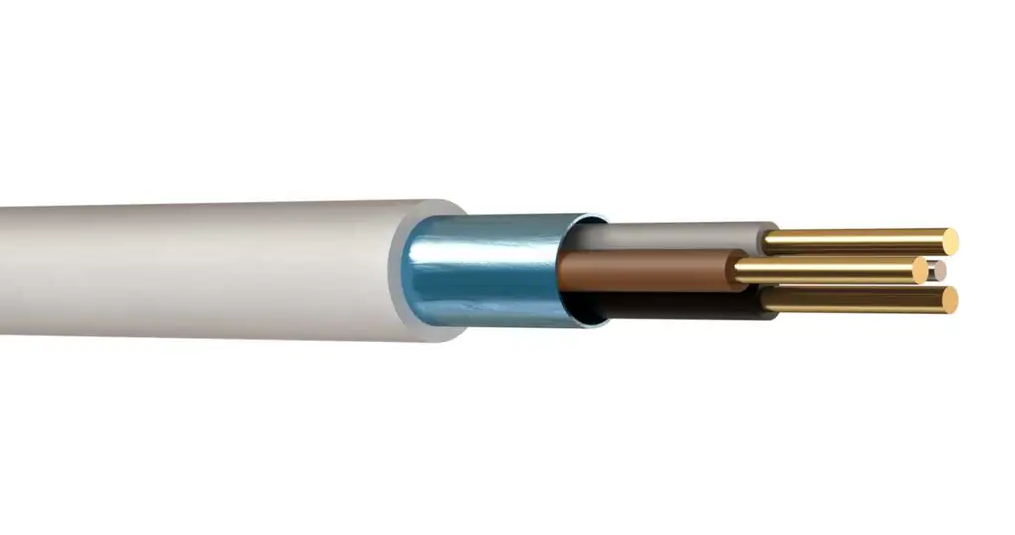
Before FP200, the standard fire resistant cable was MICC — Mineral Insulated Copper Clad. MICC has a seamless copper outer sheath with conductors insulated by compressed magnesium oxide powder. No plastic anywhere in the construction, which means in a fire it simply doesn't burn. It's been installed in churches, blocks of flats and commercial buildings since the 1950s, and a lot of it is still in service today.
The problem with MICC is everything else. Magnesium oxide absorbs moisture from the air, which means every termination requires specialist fittings, moisture seals, and a trained operative who knows exactly what they're doing. Cut into MICC without the right equipment and you risk moisture ingress that causes insulation faults across the whole circuit — faults that are genuinely difficult to trace and expensive to rectify.
FP200 fire resistant cable was developed to achieve the same fire performance — a circuit that keeps working in a fire — without the cost, complexity and moisture sensitivity of MICC.
The construction of FP200 is straightforward but effective. Copper conductors sit at the core. Around those conductors is a layer of mica tape. Over that is a LSOH (Low Smoke Zero Halogen) or PVC outer sheath.
The mica tape is what makes it fire resistant cable in the true sense. Mica is a naturally occurring mineral that can withstand extreme temperatures without breaking down. When a fire burns through the outer sheath — which it will — the mica layer remains intact and continues to insulate the conductors. The circuit keeps working. The fire alarm keeps sounding. The emergency lights stay on.
FP200 fire resistant cable is independently tested and classified under BS EN 50200, and meets the installation requirements set out in BS 5839 for fire detection and alarm systems and BS 5266 for emergency lighting.
The colour is the immediate identifier. FP200 fire resistant cable has a distinctive red outer sheath — not a bright pillar-box red, but a warm, muted red with a slight orange tone. It's a colour that becomes immediately recognisable once you've worked with it, and that recognition is the point.
Any competent electrician on site will see red cable and immediately treat it as a fire-critical circuit. You don't cut it, disconnect it or re-route it without understanding exactly which system it's feeding and what the consequences of interrupting it would be. The colour coding is essentially a built-in safety warning.
FP200 fire resistant cable is stiffer than standard twin and earth but considerably more flexible than MICC. Common sizes run from 1.5mm² through to 4mm² for most fire alarm and emergency lighting circuits, with larger sizes available for power feeds to fire-critical plant and equipment.
 Where Is Fire Resistant Cable Installed?
Fire resistant cable is required wherever a circuit must remain operational during a fire. In buildings across Kent — from care homes in Tunbridge Wells to blocks of flats in Tonbridge and commercial premises in Sevenoaks — that typically means the following applications:
Fire alarm systems — The complete fire alarm circuit, from the mains supply feed to the control panel through to every detector, sounder, call point and interface device, should be wired in fire resistant cable. This applies to any building with a fire alarm installation — commercial premises, schools, offices, shops, care homes and residential blocks.
Emergency lighting — Emergency lighting circuits must maintain illumination on escape routes when normal power fails. Fire resistant cable is standard specification for these circuits in commercial and multi-occupancy buildings.
Sprinkler pump supplies — The cable feeding the pump that maintains water pressure in an automatic sprinkler system must be fire resistant. A standard cable failing early in a fire renders the sprinkler system useless at the critical moment.
Smoke extract and pressurisation systems — Fans that remove smoke from stairwells and corridors, keeping escape routes clear, need fire resistant cable supplies.
Firefighters' lifts — In taller buildings, the circuits powering designated firefighter lifts must use fire resistant cable.
Communal areas in residential blocks — Stairwells, corridors, plant rooms and any shared circulation space in a building where people live or sleep typically fall within the scope of fire resistant cable requirements.
The consistent logic is consequence. If a circuit failing in a fire puts lives at risk, fire resistant cable is the correct specification.
Standard terminations. FP200 fire resistant cable terminates into standard connectors, back boxes and enclosures. No specialist fittings, no brass glands, no termination pots, no moisture seals. On a complete fire alarm installation, the time saved across every single termination adds up to a very material reduction in labour cost.
No moisture risk. Because FP200 uses mica tape rather than hygroscopic mineral powder, cutting, joining and terminating the cable carries no risk of moisture ingress. Extending or modifying a fire resistant cable circuit is a straightforward task.
Flexibility and ease of routing. FP200 bends and routes like standard cable. MICC is rigid and must be handled carefully to avoid fracturing the mineral insulation. The flexibility of FP200 makes fire resistant cable installation faster and reduces the risk of inadvertent damage.
Lower overall cost. The cable is less expensive than MICC. The termination hardware is less expensive. Installation is faster. The combined saving across a complete fire resistant cable installation in a medium-sized commercial building is substantial.
Accessible skills. FP200 fire resistant cable can be installed correctly by any NICEIC-registered electrician working to the relevant standards. You are not dependent on finding an operative with specific MICC experience.
This is the area where corners get cut and where the consequences directly undermine the purpose of the cable.
Fire resistant cable must be fixed using metal clips — not standard plastic cable clips.
In a fire, plastic clips melt. When they fail, the cable drops away from the surface. The weight and movement of unsupported cable can then fracture the mica insulation layer inside, causing the circuit to fail. The cable has done its job. The clips haven't. The circuit fails regardless.
Steel or stainless steel clips maintain their position at the elevated temperatures involved. The cable stays fixed, the mica stays intact, and the fire resistant cable circuit keeps working.
Clipping centres are specified in BS 5839-1 and must be followed. For FP200 fire resistant cable on horizontal runs, the standard is typically no more than 300mm between clips for smaller cable sizes, with vertical runs at around 400mm. These are performance-tested requirements, not guidelines.
Think of the whole assembly as a chain. The mica insulation is the strongest link. Inadequate clipping is the weak link. The chain fails at the weak link regardless of how good the fire resistant cable is.
If you manage an older building in Kent — a church, a block of flats, or a commercial building from the 1970s or 80s — there is a good chance MICC fire resistant cable is still feeding your fire alarm or emergency lighting systems.

MICC in good condition with all terminations intact can continue to function correctly. Annual fire alarm inspection includes insulation resistance testing, and any deterioration in those results is an early indicator of developing cable issues.
Where it becomes problematic is when the system needs extending or when insulation resistance testing reveals faults consistent with moisture ingress. In those situations, replacing the affected sections with FP200 fire resistant cable is typically the most practical route. The fire performance is equivalent, future modifications become straightforward, and specialist MICC skills are no longer required on every subsequent job.
Landlords and managing agents — Fire alarm and emergency lighting circuits are a legal compliance matter. The condition of the fire resistant cable infrastructure — not only the devices — is within scope.
Care home managers — Your fire safety obligations are among the most stringent of any building type. Fire resistant cable installed to the correct standard, with appropriate metal fixings, is the baseline requirement.
Commercial property owners and facilities managers — Any extension, modification or upgrade to a fire alarm or emergency lighting system should use fire resistant cable specified and installed to the relevant British Standards. If the contractor quoting for the work isn't talking about FP200 and metal clips as standard, that's worth questioning.
We carry out fire resistant cable installation, fire alarm cable assessment and MICC remediation work across Tonbridge, Tunbridge Wells, Sevenoaks, Crowborough and the surrounding areas of Kent.
If you're not sure what type of fire resistant cable is in your building, what condition it's in, or whether a planned installation is being specified correctly, get in touch. We'll give you a straight assessment.
Bright Spark Electrical Services
01892 531 728 | karen@brightsparkelectrician.co.uk
Serving Tonbridge, Tunbridge Wells, Sevenoaks, Crowborough and surrounding areas of Kent.
"I have had Bright Sparks at my property twice in the last six months to complete some electrical work. I have been blown away by the innovative efficient way I am communicated with the efficiency and ease of the process. The work has been carried out to a more than satisfactory standard and I found it to be extremely competitively priced. It is by far the best experience I have had with any service provider in forever. Thanks guys."
Karen and her team of electricians are super responsive, very professional, and I love how they book an exact time and appointment with a follow-up confirmation text and email. I feel very confident in the quality of workmanship and know they will go out of their way to fix any electrical issues in my home!
The two guys from Bright Sparks arrived promptly as arranged. Took their outdoor boots off before making their way to the job - a nice touch . Efficient, pleasant; I could not have asked for more. When the invoice arrived I was also pleasantly surprised. Overall a good experience 10/10
I have used Bright Sparks for two jobs and have been delighted with the quality of the work carried out. Karen is very knowledgeable in her subject and her staff are very well trained , courteous and hard working. I would highly recommend the company without hesitation.
I had no electricity and phoned up in very late evening. Karen phoned me back despite it being late evening and sorted out my problem on the phone . Great service, extremely helpful and quick response and I didn’t even have to pay for a visit. Thoroughly recommend this company and will definitely use them again.