
Where Bright Ideas
Come to Life!
Come to Life!
A ring final circuit is a socket circuit wired as a continuous loop. The cable leaves a 32A breaker in your consumer unit, visits every socket in turn, and comes back to the same breaker. If your home in Tonbridge, Tunbridge Wells or Sevenoaks was built or rewired any time from the 1950s onwards, there's a very good chance your sockets are on one.
I've been an electrician for over 25 years, and I'd say ring final circuits are the most misunderstood part of a British home's wiring. People hear the word "ring" and assume it's either outdated or somehow extra safe. Neither is quite right. A properly installed, properly tested ring is a perfectly good circuit. A ring with a hidden break in it is a fault waiting for the right load on the wrong day.
This article is a deep dive into rings specifically: how they work, the rules they're meant to follow, the faults my team and I find on site, and how we test them. If you want the head-to-head comparison with radial circuits, I've covered that separately in Ring vs Radial Socket Circuits.
Think of it like a circular bus route. The bus leaves the depot, stops at every socket on the route, and returns to the same depot. Because the route is a loop, every stop can be reached from two directions.
Electrically, that's exactly what happens. Each socket on a ring has two cables arriving at it: one coming in from the previous socket, one heading out to the next. The line, neutral and earth conductors all form their own complete loop, and both ends of each loop land on the same terminal in the consumer unit.
The word "final" just means it's the last circuit in the chain. It feeds the things you actually plug in, rather than feeding another distribution board.
The clever bit is that current shares the work. When you plug a kettle into a socket halfway round, current flows to it along both legs of the loop at the same time. So each leg of 2.5mm² cable only carries part of the load. That's how a ring gets away with smaller cable than you'd need to run the same 32A on a single straight run.
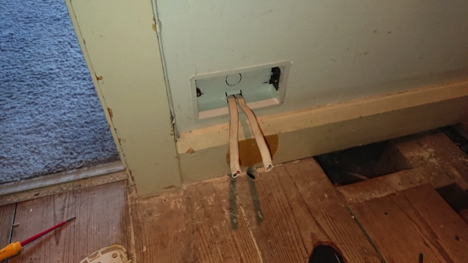
[PHOTO: Back of a double socket with two sets of 2.5mm² twin and earth cables entering — showing the two "legs" of the ring]
Ring final circuits are a British invention, born out of the years after the Second World War. Copper was scarce and expensive, the country needed to build and repair a huge number of homes, and households were starting to own more electrical appliances than the old round-pin socket systems could cope with.
The ring solved several problems at once. It used less copper per socket, it could serve a whole floor of a typical house from a single breaker, and it paired neatly with the new rectangular three-pin plug with its own fuse inside. That fused plug is the key. Because each appliance carries its own small fuse, the circuit itself can be protected at 32A without the flex on your bedside lamp being overloaded.
That combination became the standard across the UK for decades. Across Kent, most of the 1950s to 1990s housing stock I work in has rings throughout, and plenty of newer homes do too. It's only fairly recently that more electricians, including us on many jobs, have started favouring radial circuits for new work. I'll come back to why later on.
The standard domestic ring is wired in 2.5mm² twin and earth cable, protected by a 30A or 32A device, and serves a floor area of up to 100m². Those figures come from the standard circuit arrangements in BS 7671 and its supporting guidance, and they're what any electrician designing or checking a ring will start from.
There are a few other rules that matter just as much. The load should be spread reasonably evenly around the ring, rather than concentrated at one end. That's why a kitchen often gets its own ring separate from the rest of the house: a kettle, toaster, microwave and dishwasher all bunched together on a shared ring is exactly the sort of uneven loading the regulations warn against. Big fixed loads like an electric shower, cooker or EV charger should never be on a ring at all. They need their own dedicated radial circuit.
Under the current edition of BS 7671, socket outlets rated up to 32A also need additional protection by a 30mA RCD, whether that's an RCD covering a bank of circuits or an RCBO on each one. If your consumer unit predates that requirement, your rings may have no RCD protection. That doesn't make your installation illegal overnight, but it's one of the most common observations we record on an EICR.
Finally, a ring has to genuinely be a ring. Both ends must land in the same breaker, every socket must sit on the loop, and nothing should be cross-linked to another circuit. It sounds obvious. On site, it's far from guaranteed.

Yes, but there are limits, and this is where a lot of DIY and handyman work goes wrong.
A spur is a single cable branching off the ring to feed a socket that isn't on the loop itself. Going back to the bus analogy, it's a side road off the circular route that dead-ends.
An unfused spur, wired in the same 2.5mm² cable, is allowed to feed just one single socket, one double socket, or one fused connection unit. It must come from a socket on the ring or a proper joint in the ring cable, and you can't take a spur off a spur. The total number of unfused spurs shouldn't exceed the number of sockets on the ring itself. The reason is simple. A spur only has one path back to the breaker, so its cable isn't sharing the load the way the ring does. Hang too much off it and that single cable is carrying more than it was designed for, with a 32A breaker that won't step in until things are already too hot.
A fused spur is different. It comes off the ring through a fused connection unit, usually with a 13A fuse, and that fuse protects everything downstream. That's the right way to feed things like an outside socket, a boiler, an extractor fan or a small run of extra outlets. I've covered these in more detail in our Fused Spurs & Isolation Switches section.
The pattern I see most often is a spur taken off a spur taken off a spur, usually added over the years each time someone wanted "just one more socket". Every individual job looked harmless. Together, they've turned part of the ring into an overloaded tree.
The most common ring fault is a broken ring, and the dangerous thing about it is that nothing seems wrong. If one leg of the loop is disconnected, say a conductor has pulled out of a socket terminal, every socket still works. Power simply reaches them all from the other direction. The ring has quietly become two long radial arms, each one wired in 2.5mm² cable but still protected by a 32A breaker designed for a complete loop.
That's the problem in a sentence. The cable is now capable of carrying less than the breaker will allow before it trips. Plug a heater and a tumble dryer into the far end and the cable can run hot for hours without the breaker ever noticing. Over months and years, that heat cooks the insulation and the socket terminals. I've taken off sockets that looked spotless from the front and found scorched, brittle terminals behind the faceplate.
The second fault I see a lot is an interconnection, sometimes called a bridge or a figure of eight. That's where someone has linked two points on the same ring together, often during a kitchen refit or an extension. It can also happen between two separate rings, which is worse, because isolating one breaker no longer makes those sockets dead. That's a serious hazard for anyone working on the circuit later, including us.
The third is the one I've already mentioned: spurs that break the rules, spurs off spurs, and fused connection units that have been replaced with plain sockets.
Almost all of these trace back to changes made after the original installation. Socket moved during a refurb, kitchen fitted, loft converted, a well-meaning relative adding a double socket behind the TV. None of it shows up in daily use. It only shows up when someone tests the circuit properly.

We carry out a ring final circuit continuity test, in three stages, with the circuit isolated and locked off. It's a standard part of every EICR and of signing off any new or altered ring.
First, we disconnect both ends of the ring at the consumer unit and measure the resistance end to end on the line conductor, the neutral and the earth. On an intact ring in 2.5mm² cable, line and neutral should read almost exactly the same, and the earth reading should be around 1.67 times higher because the earth conductor is smaller at 1.5mm². If any reading is open circuit, the ring is broken. If the figures don't match up, something is wrong with a joint somewhere.
Second, we cross-connect the ends, joining the line of one leg to the neutral of the other, and then measure line to neutral at every socket. On a healthy ring, every socket gives roughly the same reading. A socket that reads noticeably higher is usually on a spur, and readings that climb steadily towards the middle of the ring point to an interconnection or an incorrectly wired leg.
Third, we repeat the process with line and earth cross-connected. This confirms the earth loop is continuous to every point and gives us the highest R1+R2 value for the circuit, which feeds into the fault loop impedance checks that show the breaker will disconnect fast enough if a fault occurs.
It's methodical and it takes time, especially on a large house with sockets behind fitted furniture. But it's the only way to prove a ring is a ring. A plug-in socket tester from a DIY shop cannot detect a broken ring. The socket will light up all green while one leg of the loop sits disconnected in the wall. If you'd like to know more about the wider inspection, our Electrical Testing section explains what an EICR covers.
No. Ring final circuits are still fully permitted under BS 7671, and there is no requirement to replace a sound, well-tested ring. If yours passes its continuity tests and has suitable protection, it can carry on doing its job for many years.
That said, the trade has been moving towards radial circuits for new work, and we're part of that shift. A radial is one cable, one direction, ending at the last socket. When it develops a fault, the sockets beyond the fault usually stop working, so you know about it. A ring can lose half its loop and carry on as normal. As I said on the ring vs radial page, a circuit that fails loudly gets fixed; a circuit that fails silently doesn't.
Radials are also simpler to test, simpler to extend correctly, and modern homes tend to concentrate their heavy loads in fewer places, which suits them well. On a full rewire, we'll design the socket layout around the house and how you live in it, and often that means a mix: radials for kitchens, utility rooms and home offices, and either radials or rings elsewhere.
So my honest recommendation is this. If you have rings, don't rip them out. Get them tested. If you're rewiring, extending or refitting a kitchen, talk to us about whether a radial layout makes more sense. More on that in our Rewiring Your Home section.
Homeowners. If your house has had a kitchen fitted, an extension built or sockets added since it was last tested, there's a real chance one of your rings has been altered. If you can't remember your last EICR, or you've never had one, it's worth booking. We recommend a test at least every ten years for an owner-occupied home, and before you buy or sell.
Landlords and letting agents. Rented homes in England need an EICR at least every five years. Rings in rented property get changed more than most: tenants come and go, handymen add sockets between lets, and nobody keeps a record. Broken rings and unfused spurs crop up regularly on the reports we write, and both can lead to remedial work you'll need to complete within the legal deadline.
Care homes. Residents often rely on equipment that's plugged in around the clock, from air mattresses to hoists and heaters. That kind of steady, concentrated load is exactly what finds the weak spot in a broken ring. If you have your own maintenance team, it's vital they understand that adding an outlet to a ring is design work that needs testing afterwards, not a quick swap.
Commercial premises. Offices, shops and workshops change layout constantly, and rings get extended to follow the desks. Combine that with kettles, heaters and IT equipment and you have uneven loading on circuits that may not be complete loops any more. Periodic testing, typically every five years, is the only way to know.
Kitchen and bathroom installers. Kitchen refits are where I find more ring faults than anywhere else. If you're fitting a new kitchen, it's the ideal moment to have the circuit tested, and often to put the kitchen onto its own radial or ring designed for the appliances going in.
You can't tell reliably from the socket itself. A clue is a 32A breaker labelled "sockets" or "ring" in your consumer unit, but the only way to confirm it is a continuity test by a qualified electrician.
Yes. A broken ring leaves sections of 2.5mm² cable protected by a 32A breaker that may not trip before the cable overheats under heavy load. Over time that heat can damage insulation and socket terminals.
Usually not. Every socket still receives power from the other direction, which is exactly why broken rings go unnoticed for years.
Up to 100m² of floor area under the standard BS 7671 arrangement, using 2.5mm² cable on a 30A or 32A protective device.
A portable heater on a sound ring is fine. Avoid running several high-wattage appliances from one socket or adaptor, and if your ring hasn't been tested recently, get it checked before relying on heavy loads through the winter.
Under the current edition of BS 7671, socket outlets up to 32A need 30mA RCD protection. Older installations without it aren't automatically unsafe, but upgrading is one of the most worthwhile improvements you can make.
Not if they test sound. Consider radials when you're rewiring, extending or refitting a kitchen.
If you're not sure whether your rings are intact, or you've had work done since your last test, my team and I can find out. Bright Spark Electrical Services is NICEIC registered, and we test, repair and install socket circuits for homeowners, landlords, care homes and businesses across Tonbridge, Tunbridge Wells, Sevenoaks, Crowborough and the surrounding area.
We aim to attend emergencies the same day, with small works typically booked within one to two weeks and larger projects within three to six weeks.
Call us on 01892 531 728, email karen@brightsparkelectrician.co.uk, or request a quote online.
Karen was amazing I can not recommend her highly enough she went over and above my expectations and was indeed a bright spark to my day and helped with love ❤
We are very pleased with the high standard of the recent work carried out by Bright Spark and would happily recommend the service. We were particularly impressed by the quick response to our online enquiry and the email follow up by Karen after the job had been completed. We will definitely use her for any electrical job in the future.
Karen runs a great company. She is that very rare breed of taking care, respecting and rewarding her employees. In turn, Terry who carried out our work showed due care and attention and completed works with such professionalism. He interacted with my inquisitive little boy who may, one day may, become an electrician - he certainly had a great role.model to follow!
The two guys from Bright Sparks arrived promptly as arranged. Took their outdoor boots off before making their way to the job - a nice touch . Efficient, pleasant; I could not have asked for more. When the invoice arrived I was also pleasantly surprised. Overall a good experience 10/10
I live in a very old house with many different electrical systems. As a condition of my household insurance I had to have the house electrics upgrade to a modern standard. I engaged Bright Spark for the complex project. My experience of their service was that they are a highly professional company who completed the work on time and on budget. However, and just as importantly, the work was carried out with consideration and care, sadly a rare occurrence in today's society. I have no hesitation in recommending Bright Spark to my friends.