Where Bright Ideas
Come to Life!
Come to Life!

There's something genuinely magical about a garden that comes to life at night. During the day, your planting, your landscaping and your hard work speak for themselves. Once the sun goes down, without the right lighting, all of that disappears. The right garden lighting doesn't just make a space visible — it creates atmosphere, extends the usable hours of your garden, adds security, and can make a well-designed garden look even better at night than it does in daylight.
At Bright Spark Electrical Services, we carry out garden lighting installations across Tonbridge, Tunbridge Wells, Sevenoaks, Crowborough and the surrounding areas of Kent. I'm Karen Smith, Director and a qualified electrician with over 25 years of experience. I also hold a degree in horticulture — so when it comes to highlighting plants, shrubs, trees and planting schemes, I'm not guessing. Combined with our team of NICEIC-registered electricians working to Part P and BS7671, you get horticultural knowledge and electrical expertise under one roof.
Garden lighting done poorly tends to fall into one of two camps. Either everything is lit equally, which creates a flat, car-park effect with no atmosphere, or random features get lit with no coherent logic, so the garden feels busy rather than considered.
Good garden lighting works like theatre lighting: you decide what you want people to notice — a specimen tree, an ornamental urn, the pergola where you eat in summer — and use light to draw the eye there, letting other areas sit in softer light or shadow. Contrast is everything; without darkness, there's nothing for the light to work against.
When we survey a garden for a lighting scheme, we'll usually come back in the evening too, so we can walk around together and talk about what matters to you and where you want the atmosphere to sit. It's far harder to retrofit a bad lighting scheme than to plan a good one from the start.
The workhorse of most garden lighting schemes is the adjustable, spike-mounted garden spotlight — versatile because you can point it wherever you need it, and reposition it as your garden changes through the seasons.
Spotlights highlight individual plants and planting groups: a statement phormium, an ornamental grass, a shaded hosta clump, or a climbing rose all become focal points after dark. Beam angle matters here — narrow beams (15–25°) create a tight, dramatic pool of light for specimen plants, while wider beams (40°+) wash broader areas for drifts of planting or mixed borders.

For ornamental features — urns, sculptures, large pots, birdbaths — one well-aimed spotlight from slightly off-centre tends to look more interesting than two lights pointed straight on, because you get shadow and depth rather than a flat effect.
Lattice fencing and trellis panels catch light differently to solid fencing: light passing through the gaps projects a pattern onto nearby walls, paving and planting that adds real texture. Shrubs and hedges respond well to spotlighting from below, particularly evergreens with interesting texture like box balls or yew hedging — and deciduous shrubs take on a skeletal, structural quality in winter when they're leafless.
Up-down lights are wall-mounted fittings that throw light both upward and downward simultaneously — elegant and architectural on any vertical surface: the house, boundary walls, garden buildings or outbuildings.
On the house, up-down lights mounted at intervals add sophistication that porch lights can't match, creating rhythmic pools of light you notice looking back at the house from the garden. On boundary walls, they add definition and guide the eye around the perimeter, which works well for larger gardens. On garden buildings — summer houses, home offices, cabins — they make the structure feel like a proper feature rather than a functional box, and let you navigate to and from it after dark.
Fittings need to be IP-rated for outdoor use, and we'd always specify LED for efficiency and longevity, in warm white.
Ground lights — also called inground or recessed path lights — sit flush with the surface of your paving, patio or decking. Done well, they're one of the most elegant options in a scheme; done badly, spaced like a runway, they look like you're about to take off.
In pathways, they mark the route from house to garden cabin, or patio to gate, without overhead lighting that can feel harsh. On a patio, they can define the perimeter or be used sparingly as accent points. On decking, they're very effective along steps or level changes where you want to define the edge for safety as well as aesthetics.
Because they're flush to the surface, wiring has to come up from beneath, so cable routes need planning at the point of installation — ideally while paving or decking is being laid. If you're having landscaping work done, it's worth having us in at the same time, or at least talking through conduit routes before the slabs go down.
A pergola or gazebo is one of the most rewarding places to get lighting right, because it's the space you actually sit in on summer evenings. A single bulkhead fitting or tired fairy lights don't do justice to a well-built structure.
Small adjustable spotlights mounted in the corners, pointing downward onto the seating or dining area, work very well — closer in quality to candlelight than overhead lighting, and low profile enough not to distract from the architecture in daylight. If you move the table, you move the aim of the spotlight in thirty seconds. LED spotlights here draw very little power, so a full set running four hours an evening costs pennies — the investment is in a neat installation, not ongoing energy use.
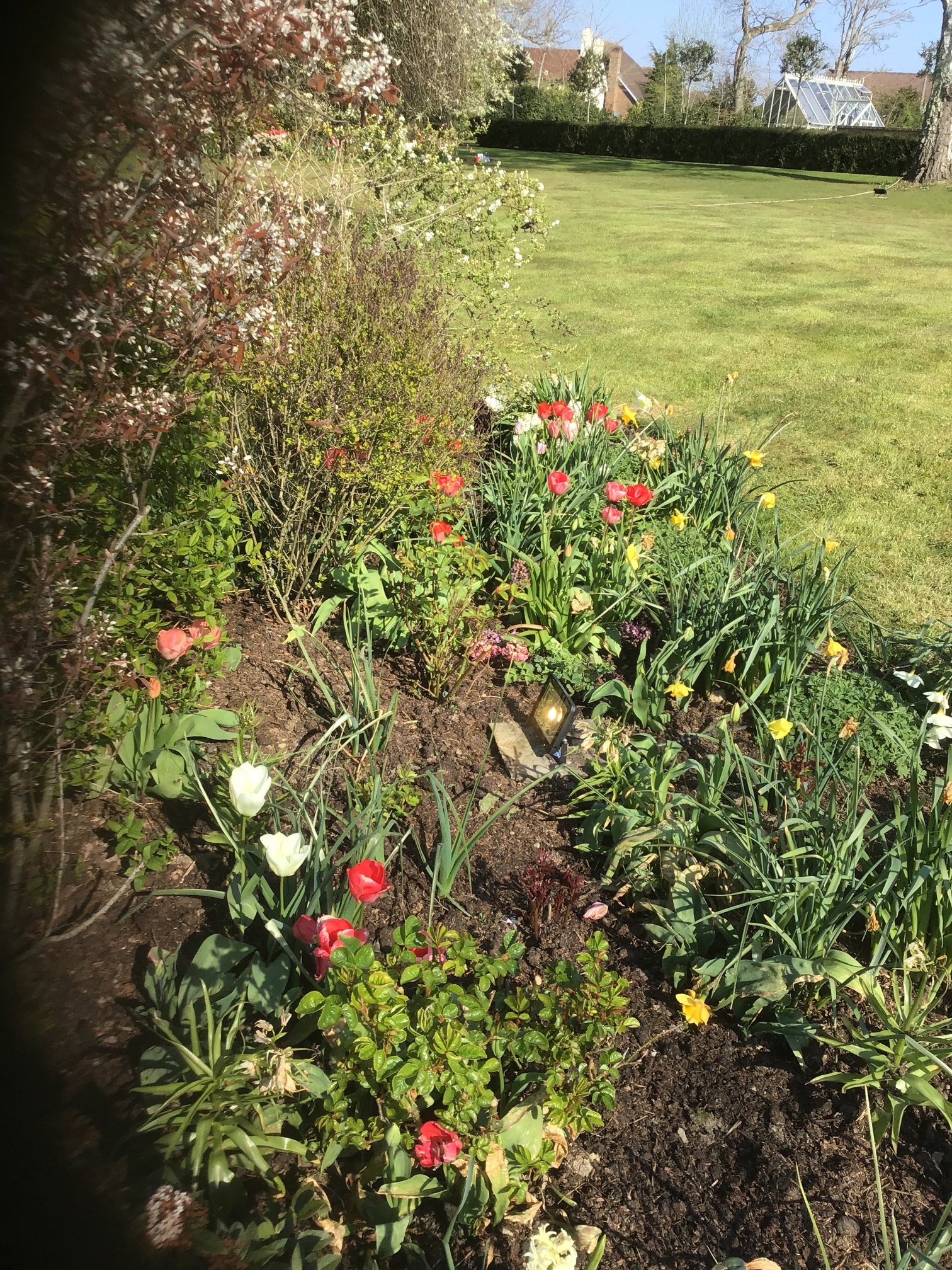
For mature trees — an established oak, ornamental cherry, large pine or cedar — we use low-energy LED floodlights, surface-mounted onto a paving slab and aimed upward into the trunk and canopy. A well-lit specimen tree becomes the centrepiece of the garden at night, showing bark texture and branch structure you don't see in daylight.
We mount these on a paving slab rather than pushing a spike into the ground because a fitting in the ground near a large tree is a cable hazard during lawn mowing. Mounting on a slab lets the cable route beneath it, away from the mower deck, and keeps the fitting stable and level for accurate beam aiming. Fittings are IP65-rated, low-energy LED and warm white; multiple fittings are often used on very large trees for three-dimensional illumination.
Post lights add vertical interest and work well ground-mounted alongside a path or driveway, or fitted to the top of a wall or gate pillar.
Ground-mounted post lights along a path or driveway light the route, define the edges, and add a sense of occasion — particularly on a longer driveway. Wall-top and pillar-top post lights mark an entrance or gateway, and work particularly well in pairs either side of a gate, where the symmetry feels considered. As with all external fittings, post lights need to be IP-rated and wired to BS7671 and Part P, which matters especially where exposure to moisture and ground movement is a factor.
Beyond the standard post light, there's a category that makes a genuine statement in a larger garden or a property with the right character — cast iron or cast aluminium column lights modelled on Victorian and Georgian street lighting, scaled for private gardens and driveways.
We install these from around 2 metres, for an intimate scale flanking a front entrance or terrace, up to 3.5–4 metres for a full-height presence on a long driveway or at the entrance to a larger property. At the taller end, a single lantern column sets the tone for the whole property from the road, and a pair flanking a gate is genuinely striking. All are fitted with low-energy LED sources in warm white, and every installation includes proper foundation work — a concrete pad engineered for the height and weight of the column, with below-ground cabling run in SWA and hazard warning tape above, as with any buried garden circuit.
At the opposite end of the aesthetic spectrum from the Victorian lantern sits the modern bollard light — low-level fittings, typically 0.5–1.5 metres, with a clean contemporary profile. For domestic use, they suit longer driveways and contemporary gardens with hard landscaping and minimal planting, where a period lantern would look out of place.
For commercial clients — small businesses, car parks, office grounds, storage facilities, landscaping and garden maintenance companies with yard areas — bollard lighting is often the practical choice for access routes, parking areas and pedestrian paths, keeping the fitting below eye level so there's no glare for drivers or pedestrians. As with column lights, every bollard installation includes proper foundation work so it stays true and secure for years.
Decorative wall lights along fence lines and boundary walls add ambient light at a comfortable eye height, and give the boundary a character and warmth a bare fence doesn't have. They range from a clean, minimal fitting in brushed steel or matte black for a contemporary garden, to a lantern-style fitting in heritage black or antique bronze for a cottage garden — the fitting is visible in daylight too, so it should be chosen with the overall aesthetic in mind. Spacing matters: we'd typically advise 1.5–2.5 metres depending on beam spread, close enough to keep warmth between pools of light without isolated bright patches.
Brick lights, or step lights, are recessed fittings that sit within a wall face, casting light sideways and downward across steps, paths or level changes — understated by day, highly effective at night. Their primary function is safety, clearly illuminating the edge of each step, though they also add texture to the wall and a tidy, built-in look.
They can also run along low retaining walls beside a pathway, washing light across the surface at low level — particularly effective on curving paths, where the light sweeps naturally and leads the eye forward. Installation is more involved than surface-mounted fittings, since the wall has to be cut out for the recessed housing, so brick lights are best planned from the start of a project rather than retrofitted.
This is the part that doesn't look exciting but is critical to a safe, durable and compliant installation. For all underground cable runs, we use Steel Wire Armoured (SWA) cable — a layer of steel wire around the core conductors gives mechanical protection against a garden fork or ground movement, and it's what BS7671 requires for buried cable without additional physical protection.
SWA is buried with protective ducting around it, and because the cable itself is black and not inherently visible, a strip of hazard warning tape is laid a few centimetres above before the trench is backfilled — so anyone digging hits the tape first. Cable runs are buried to a depth that complies with current wiring regulations, and we provide customers with a simple record of where cables
Where cable follows a low wall or fence rather than being buried, it can be surface-routed and clipped neatly to the structure — less discreet, but entirely safe and compliant, and a good option where digging isn't practical. For flexible connections to individual spotlights, particularly ones you might want to reposition, we enclose the cable in protective flexible conduit — so a fitting can be moved without disturbing the buried run beneath, and the cable isn't damaged by someone spreading mulch or bark chippings around a border.
The traditional approach is a wall switch inside the house or garden building, fed by a dedicated circuit from the consumer unit and protected by an appropriate MCB and RCD. Separate switches give you control over different zones — front spotlights, path lights, pergola lights — and it's simple, reliable and familiar.
The modern alternative, which we're fitting increasingly often, is wireless switching control. A central control receiver box — inside the house, in a garage, or in the garden cabin — takes the main supply and distributes it to individual lighting circuits, with wireless receiver modules handling the switching for each zone. This significantly reduces the number of cables needed back to the house, because the box acts as a local distribution point.
Control is then via a wireless switch, which can be built into an existing wall switch plate without any rewiring, or adhesive-fixed as a surface-mounted switch wherever suits you — no chasing, no replastering. Many systems also allow app control, so you can switch zones on or off, or set them to come on automatically at dusk, from anywhere — useful for security as much as convenience.
Submersible LED pond lights sit within the water and illuminate a pond from below the surface. On a clear-water pond with fish, the effect is extraordinary; on planted ponds, the light picks out stems and root structures in a way you can't replicate any other way. For fountains, millstone features and cascades, lighting the water in motion creates a constantly changing, compelling effect.
Wireless switching for pond lights and water features works exactly as described above — the same control box can handle pond lighting and pump switching alongside the wider garden lights, giving you unified control from a single switch or app. All electrical work in and around ponds must comply with the relevant regulations for wet and immersed installations — this isn't an area for improvisation, and we always use appropriate protection devices and IP-rated fittings suited to continuous submersion.
While this article focuses on atmospheric garden lighting, most of our installations include an element of security lighting too. PIR-activated LED floodlights — motion-sensor lights that come on when they detect movement — are a well-established deterrent for the rear and sides of a property, garden buildings, garages and side gates.
Modern LED PIR floodlights use a fraction of the energy of the halogen units they've replaced, last years rather than months, and have more sensitive, reliably aimed sensors. A PIR floodlight on a garden building is also simply practical — it comes on automatically as you approach in the evening, without you needing to find a switch.
If we're already running cables through your garden for lighting, it makes good practical sense to add weatherproof outdoor sockets at the same time — the extra cost is modest when you're already trenching, and the convenience over the years ahead is considerable.
IP-rated sockets can be mounted on the house wall, a garden cabin, boundary walls or standalone posts, giving you a safe, regulated supply for power tools during garden maintenance without extension leads trailing from the house. They're also useful for Christmas lights, a garden speaker system or simply charging a phone outside on a summer afternoon.
Colour temperature is measured in Kelvin (K), running from around 2700K (warm, slightly amber) up to 6500K (cool, blue-white, almost daylight). For garden lighting, we almost always recommend warm white, typically 2700–3000K.
Warm white is the colour of candlelight and low evening sun — it's what we associate with relaxation and evening, and it makes planting look richer, with greens appearing warmer and bark, stone and brick looking their best. Cool white (4000K+) has its place for task lighting, garages and security floodlights where you want to see clearly and quickly, but in a garden you want to spend time in, it tends to feel clinical rather than atmospheric. Every LED fitting we specify for garden lighting is warm white unless a customer specifically asks otherwise.
Yes. External electrical installations are covered by Part P of the Building Regulations and must be carried out to BS7671, the IET Wiring Regulations that govern all electrical installation work in the UK. All outdoor circuits must be protected by an RCD of the appropriate type and trip current; buried cable must be correctly rated and either mechanically protected or buried to the correct depth; all fittings must carry an appropriate IP rating for their environment; and submersible fittings must meet the specific requirements for equipment used in or around water.
NICEIC registration — which all of our electricians hold — means our work is inspected and assessed against these standards, and that we can self-certify notifiable work under Part P, issuing you with an Electrical Installation Certificate. That certificate matters for your home insurance, and it matters if you sell your property, as a buyer's solicitor will ask for it.
The best schemes come from a proper survey and conversation, not a fixed product list — every garden differs in size, planting, hard landscaping, house layout and how you actually use the space.
When we survey, we'll look at where power is currently available, the most practical cable routes, fittings that suit the style of your property and garden, and your priorities for the scheme — atmospheric lighting around a seating area, security and safety, highlighting specimen plants, or a pond or water feature as the centrepiece. Usually it's a combination, and we'll talk through options and costs at each stage so you can make informed decisions about where to invest.
It depends on the size of the garden, the number of fittings and how much cable needs to be buried, so we always price after a survey rather than off a fixed list. A single pergola or seating area scheme costs far less than a full-garden layout with tree uplighting, pathway lighting and a wireless control system.
No — garden lighting is covered by Part P of the Building Regulations rather than planning permission. It must be installed and certified by a registered electrician like Bright Spark, but there's no separate planning application needed for a typical domestic scheme.
Running mains-voltage cable outdoors is notifiable work under Part P and must meet BS7671, so it isn't a DIY job. Low-voltage solar spike lights are fine to fit yourself, but anything wired back to your consumer unit needs a qualified, NICEIC-registered electrician.
A straightforward scheme — pergola spotlights or a handful of spike lights — is usually a one-day job. Larger schemes involving buried SWA cable runs, recessed ground lights or a wireless control system can take two to three days depending on how much digging and cable routing is involved.
Not really. Every fitting we specify is low-energy LED, so even a full garden scheme running for a few hours each evening costs very little to run. The bigger cost is the installation itself, not the ongoing electricity.
SWA (Steel Wire Armoured) cable has a layer of steel wire under the sheath, giving it mechanical protection against things like a garden fork or ground movement. BS7671 requires this level of protection for cable buried in the ground without additional physical protection, so it's what we use for every underground garden circuit.
Yes, though it's more involved than fitting it alongside new landscaping. Cable has to be trenched into existing lawn or borders rather than laid before paving goes down, and features like ground lights or brick lights set into walls are more disruptive to retrofit. It's still very achievable — it just means more digging.
Yes — the wireless switching systems we install include app control, so you can turn zones on or off, or set them to come on automatically at dusk, from anywhere. It's particularly useful for security when you're away from home.
If you're thinking about garden lighting — whether you've got a clear idea of what you want or you're starting from scratch — the best first step is a conversation.
Call us on 01892 531 728 or drop an email to karen@brightsparkelectrician.co.uk to speak directly with Karen. With over 25 years of electrical experience and a degree in horticulture, that combination of horticultural knowledge and electrical expertise is what sets Bright Spark apart when it comes to garden lighting.
Alternatively, scroll to the bottom of this page and use the Request a Quote button. Give us as much detail as you can about your garden and what you're hoping to achieve, and we'll arrange a survey at a time that suits you.
We cover Tonbridge, Tunbridge Wells, Sevenoaks, Crowborough and the surrounding areas of Kent.
Terry did a nice job. More importantly my wife said, “He can come here any time.” Praise indeed!
I had an emergency situation arising from a constantly tripping appliance. A call to Bright Sparks, who have helped me before, led me to their website’s ‘Knowledge Centre’ and although I’ve used similar help sites before this was excellent – clear, well laid out, and logically organised – and as someone with zero electrical knowledge I managed to find the fault myself! I followed up the situation on the phone and got more advice. Really impressed by the Bright Sparks service and will continue to use them and their Knowledge Centre again in the future.
Thank you for attending my “Emergency Call out” there was smoke coming out of my socket. I telephoned at least 15 electricians after 7:15pm (in the evening) when we discovered the smoke coming out of the Socket. Their phones not even being answered. The next on my list was Bright Sparks, who were the only ones to answer the call - literally within a couple of rings, and was answered by a lovely lady who reassured me that help would be on the way. The Call was sent to your emergency electrician who called back within 15 minutes, and was able to attend within the hour, and fix the problem. Thank you. Excellent Service
"I have had Bright Sparks at my property twice in the last six months to complete some electrical work. I have been blown away by the innovative efficient way I am communicated with the efficiency and ease of the process. The work has been carried out to a more than satisfactory standard and I found it to be extremely competitively priced. It is by far the best experience I have had with any service provider in forever. Thanks guys."
We are very pleased with the high standard of the recent work carried out by Bright Spark and would happily recommend the service. We were particularly impressed by the quick response to our online enquiry and the email follow up by Karen after the job had been completed. We will definitely use her for any electrical job in the future.